Most social-skills apps for autistic kids were built by people who've never met one.
SparkStories is a curated library of short comic strips for autistic kids 5 to 12. Each one carries one small social-emotional skill. One question at the end. A plain-language explanation underneath. No confetti, no shouting cartoon mascot, no gold-star sticker for getting it right. And for kids who aren't reading stories yet, it starts even earlier: pointing, names and familiar faces, built from your own family photos.
Made to be done together. A grown-up sets the pace, talks through the tricky bits, and keeps an eye on each story. It's built to do alongside your child, not to hand over.
Grounded in 20+ peer-reviewed studies · a Foundations track for the earliest skills (pointing, names, faces) · 12 social-emotional skills tracked separately · 7 difficulty levels per skill · 14 languages (Arabic is native)
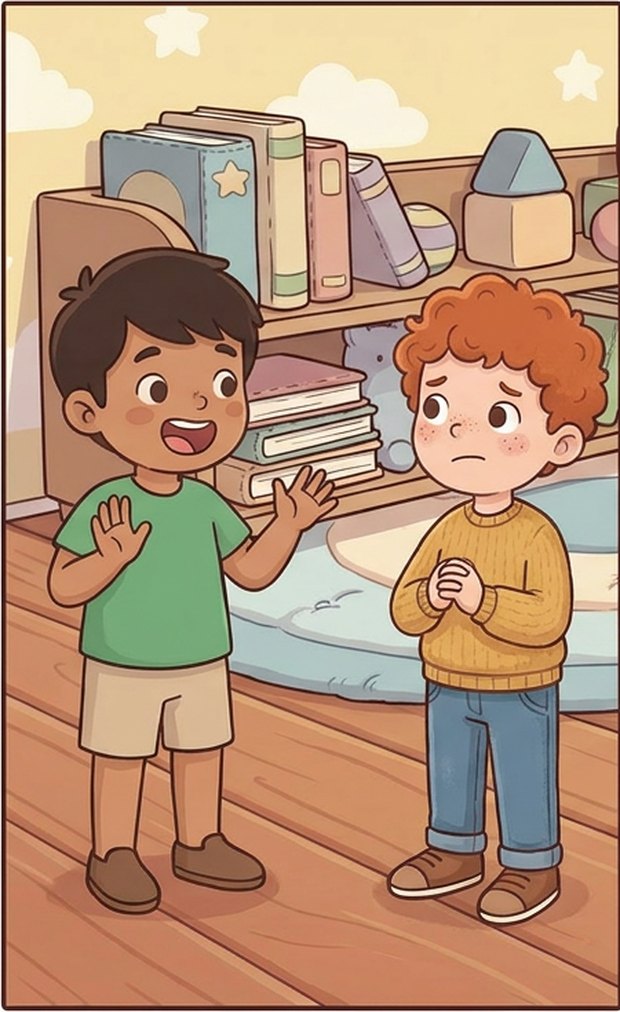
Omar waved hello. Sam felt shy.
How does Sam feel?
Where's the ball?
Tap the one they pointed to.
Before the stories come the first skills.
Not every child is ready for a three-panel story yet. So SparkStories starts earlier, with the building blocks of social attention, built from photos of your child's own family. You and your child do these together: you call, they look; you ask, they point.
Teaching pointing
"Where's Mom?" Your child points to the right photo. Pointing and shared looking is one of the earliest social skills, and one of the most important.
Knowing faces
Mom, Dad, sister, the cat. The app shows a face; you name it together. Built from your own photos, not strangers from a stock library.
Finding themselves
Your child finds their own photo among the others. Early self-recognition ("that one is me") in their own face, not a cartoon.
Responding to their name
You record your child's name in your own voice. The app calls it; the moment they look, they're rewarded. Turning a name into a cue to connect.
The photos never leave the phone. Family pictures are stored on the device only. Never uploaded, never on our servers.
Then a Basic story mode. When they're ready for stories, Basic keeps each panel to a few words and two choices. The same story, stripped right down.
What else is in there